
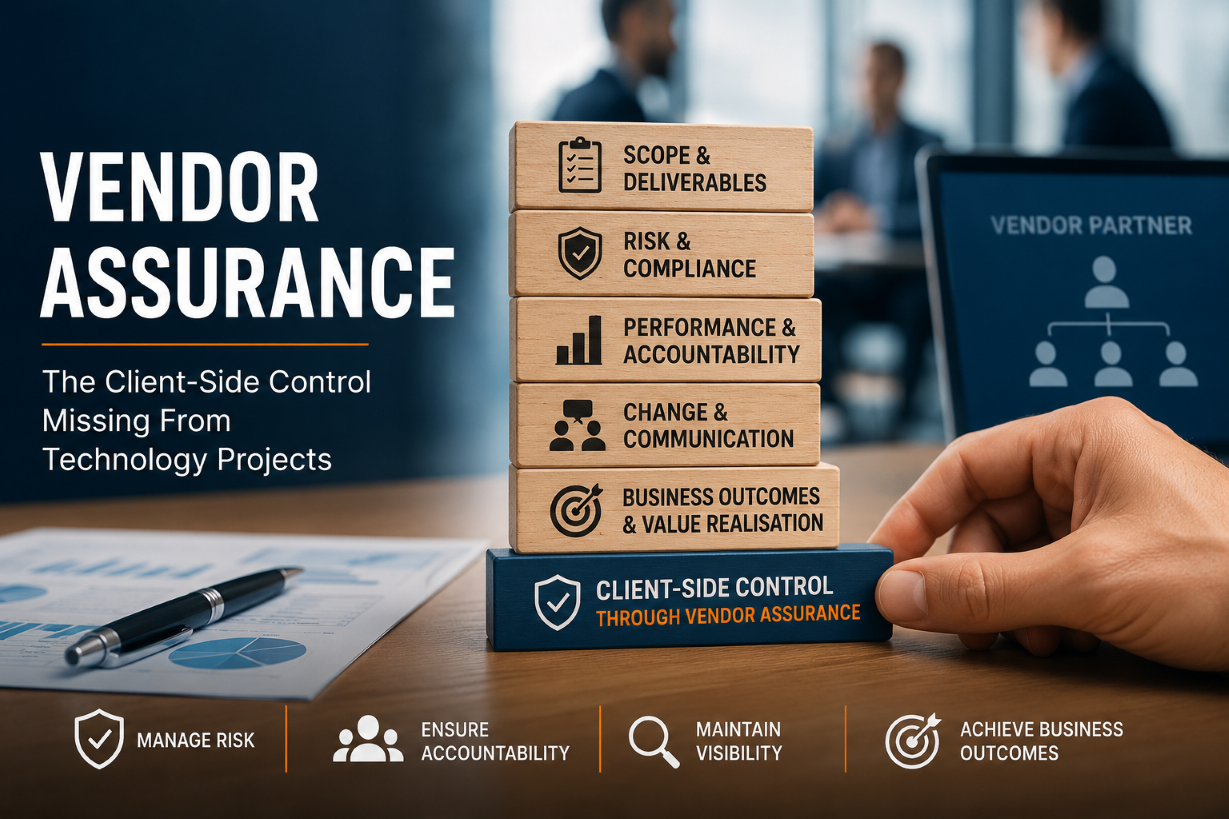
Many organisations assume vendor-led delivery reduces project risk.
A specialist vendor is selected. The contract is signed. The scope is agreed. The vendor brings its methodology, tools, implementation team and technical experience.
On paper, this should make delivery easier.
In reality, vendor-led projects often fail for a different reason. The vendor may understand the product, but the client organisation still owns the business outcome.
That distinction matters.
A vendor can configure the system, migrate the data, build the integration or deploy the infrastructure. But the business still needs to confirm whether the solution solves the right problem, fits the operating model, meets risk expectations, supports users, and can be sustained after go-live.
This is where vendor assurance becomes important.
Vendor assurance is the client-side discipline of making sure vendor activity remains aligned to business value, delivery risk, contractual obligations and operational readiness.
It is not about slowing the vendor down. It is about making sure the organisation stays in control.
Why Vendor Assurance Matters Now
Technology delivery has become more dependent on third parties.
Most mid-sized organisations now rely on software vendors, implementation partners, managed service providers, cloud platforms, integration specialists, cyber partners and niche consultants. That can be very effective, but it also creates a more complex delivery environment.
Regulators are increasingly focused on this point. APRA’s CPS 230 is aimed at ensuring regulated entities can manage operational risk, maintain critical operations through disruption and manage risks arising from service providers. ASD’s cyber supply-chain guidance also makes the same practical point from a security perspective: organisations need to identify supplier risks, set expectations, audit compliance and keep improving supplier security practices.
Even if your organisation is not directly regulated under those frameworks, the principle is useful.
If a vendor has access to your systems, data, business process, customers or operational dependencies, then vendor delivery is not just a procurement activity.
It is a governance issue.
The Real-World Delivery View
Vendor-led projects often start with confidence.
The sales process is polished. The demonstration looks good. The proposal explains the benefits. The statement of work appears clear. The implementation plan has phases, workshops and milestones.
Then delivery begins.
Requirements become more detailed. Assumptions are tested. Data quality issues emerge. Integrations become harder than expected. Business users ask questions that were not covered in the sales process. The vendor raises change requests. Internal teams realise they are needed more than expected.
None of this is unusual.
The problem is not that vendors are bad or that projects are always poorly scoped. The problem is that the gap between contract and delivery is where many risks appear.
Good vendor assurance closes that gap.
Vendor-Led Does Not Mean Vendor-Owned
A common mistake is treating the vendor as though they own the project outcome.
They usually do not.
They may own delivery of the configured solution. They may own technical tasks. They may own specific deliverables. They may own support obligations under the contract.
But the client organisation usually owns:
- the business problem
- the internal decision-making
- the operating model
- the users and adoption path
- the data quality
- the process change
- the internal controls
- the acceptance decision
- the benefits case
This is why vendor assurance should sit on the client side.
The vendor can provide evidence. The business must decide whether the evidence is good enough.
The Contract-to-Delivery Gap
Most vendor risk does not appear as one obvious failure.
It appears through small gaps that compound over time.
The scope says reporting is included, but the business has not defined what reporting actually means.
The statement of work includes integration, but not the exception handling process.
The vendor assumes the client will cleanse data. The client assumes the vendor will handle migration complexity.
The contract includes training, but only for system use, not changed business processes.
The project plan includes go-live, but not a clear hypercare model or BAU handover.
Each item may look manageable on its own.
Together, they create drift.
This is why relying only on a signed contract is not enough. A contract sets the boundaries, but assurance keeps delivery aligned while the project is moving.
What Vendor Assurance Should Cover
Vendor assurance does not need to be heavy. For most mid-sized organisations, it can be a simple set of controls applied consistently.
The aim is to make sure the right questions are being asked at the right time.
Scope and Assumption Control
The first area is scope clarity.
Vendor proposals often contain assumptions. Some are obvious. Others are buried in schedules, dependencies, exclusions or commercial terms.
A practical vendor assurance process should identify:
- what is included
- what is excluded
- what the vendor is assuming the client will provide
- what decisions the client must make
- what dependencies sit outside the vendor’s control
- what could trigger a variation
- what acceptance criteria will be used
The most important part is assumption ownership.
If an assumption proves wrong, who owns the impact?
Requirements and Business Fit
A vendor can only build or configure against what has been properly understood.
Requirements should not just describe features. They should explain the business outcome, process impact, data needs, control requirements and operational constraints.
Useful assurance questions include:
- Does the requirement link to a real business problem?
- Has the future-state process been confirmed?
- Are exceptions and edge cases understood?
- Are reporting and audit needs included?
- Have users validated the proposed approach?
- Does the solution fit the way the business actually operates?
This is especially important where a vendor is implementing a standard product. The business may need to adapt to the system, but that decision should be conscious, not accidental.
Integration and Data Risk
Data and integration issues are common sources of project delay.
They are also easy to underestimate during procurement.
Vendor assurance should test whether the project has a clear view of:
- source systems
- data ownership
- migration rules
- data-cleansing responsibilities
- integration patterns
- exception handling
- reconciliation requirements
- cutover timing
- reporting impacts
The question is not simply whether the vendor can build the integration.
The question is whether the business can trust and operate the end-to-end process once the integration is live.
Cyber and Access Controls
Vendor delivery often involves access to systems, environments, data or support channels.
That creates risk.
ASD’s guidance on procurement and outsourcing notes that managed service providers should undergo regular security assessments, including consideration of new services and security-related system changes since the previous assessment.
For practical project delivery, this means vendor assurance should check:
- what access the vendor needs
- how access is approved and reviewed
- whether privileged access is controlled
- how data is protected
- where data will be stored
- whether subcontractors are involved
- how security incidents will be reported
- what happens to access after the project ends
This does not need to become a cyber audit for every small project. But it does need to be proportionate to the risk.
If the vendor can affect your systems, data or operations, access control cannot be an afterthought.
Delivery Governance
A vendor project still needs a client-side rhythm.
This includes clear governance meetings, decision pathways, issue escalation, action tracking, risk review and progress reporting.
The reporting should show more than whether the vendor is busy.
It should show whether the project is becoming more or less certain.
Useful indicators include:
- unresolved decisions
- open assumptions
- ageing risks
- dependency slippage
- change requests
- defect trends
- business-readiness gaps
- data-quality issues
- acceptance risks
- support-readiness concerns
A green status report is not useful if it hides uncertainty.
Commercial and Change Control
Vendor change requests are not automatically a problem.
Sometimes they are valid. Sometimes the business has asked for something new. Sometimes the original scope was genuinely unclear.
The risk is accepting change without understanding the cumulative impact.
A good vendor assurance approach should ask:
- Why is the change required?
- Was it caused by new scope, missed scope or an incorrect assumption?
- What happens if the change is not approved?
- Does it affect time, cost, quality, risk or benefits?
- Are there alternative options?
- Is the business sponsor making an informed decision?
Change control should not be a commercial argument at the end of the project. It should be a controlled decision process throughout delivery.
Acceptance and Handover
Acceptance is where many organisations lose control.
The vendor says a deliverable is complete. The project team is under pressure. The business wants progress. Defects are open, but they are described as minor. Documentation is nearly finished. Support handover is planned for later.
This is where acceptance criteria matter.
Before accepting a vendor deliverable, the organisation should be clear on:
- what has been tested
- what defects remain
- what business impacts are accepted
- what documentation has been received
- what support model is in place
- what training has occurred
- what warranty or remediation obligations remain
- who owns the next step
Acceptance should not be based on optimism.
It should be based on evidence.
Warning Signs Vendor Assurance Is Weak
There are usually early signs when vendor delivery is drifting.
Common warning signs include:
- The vendor is driving the project plan without enough client challenge.
- Business owners are not involved until late testing.
- Scope assumptions are not tracked.
- Change requests appear before requirements are stable.
- Data migration is treated as a technical task only.
- Internal teams are surprised by how much work they need to do.
- Risks are discussed verbally but not formally managed.
- Vendor status reports show activity, not delivery confidence.
- Acceptance criteria are unclear.
- Support and handover are pushed close to go-live.
None of these automatically mean the vendor is performing poorly.
They mean the client-side controls need attention.
A Practical Vendor Assurance Checklist
A simple vendor assurance checkpoint can be used at key stages: before contract signing, after discovery, before build, before testing, before go-live and before final acceptance.
The checklist should confirm:
- The business problem is clearly defined.
- Vendor scope, exclusions and assumptions are documented.
- Client-side responsibilities are understood and resourced.
- Requirements are linked to business outcomes.
- Data and integration risks have owners.
- Security and access requirements are agreed.
- Decision rights and escalation paths are clear.
- Change control is active and understood.
- Reporting shows risks, not just progress.
- Acceptance criteria are measurable.
- Support, handover and hypercare are planned.
- Residual risks are accepted by the business owner.
The value is not in the checklist itself.
The value is in the conversation it forces.
How to Start Without Creating a Heavy PMO
Vendor assurance does not require a large governance function.
A practical starting point is to appoint someone on the client side to act as the delivery assurance lead. This may be a project manager, technology lead, sponsor representative or independent advisor.
Their role is to keep asking:
- Are we solving the right problem?
- Are vendor assumptions still valid?
- Are business responsibilities clear?
- Are risks being surfaced early?
- Are decisions being made by the right people?
- Are we building something the business can operate?
- Are we accepting deliverables based on evidence?
This role is especially valuable for organisations that do not run projects every day.
The vendor may know their product very well. The client still needs someone protecting the business outcome.
Governance That Creates Confidence
Good vendor governance is not about distrust.
It is about clarity.
The best vendor relationships are usually the ones where both sides understand the expectations, decision process, delivery risks and success criteria. Clear governance helps the vendor as much as the client, because it reduces ambiguity and avoids late surprises.
A strong vendor can still fail in a weak client environment.
A capable product can still miss the mark if the business problem is unclear.
A well-written contract can still lead to delivery friction if assumptions are not actively managed.
Vendor assurance helps close those gaps before they become expensive.
Need an Independent Perspective?
Every organisation’s technology journey is different.
Whether you are selecting a vendor, preparing for a system implementation, reviewing a troubled project, or trying to improve delivery governance, an independent perspective can often identify risks and gaps before they become expensive problems.
AW Projects & Consulting can help review vendor scope, delivery governance, project risk, readiness, acceptance criteria and contract-to-delivery controls.
If you would like to discuss an upcoming vendor-led initiative, AW Projects & Consulting would be happy to help.