Artificial intelligence is quickly moving from curiosity to practical business use.
For many Australian businesses, the conversation has shifted from “Should we use AI?” to “Where should we use it first, and how do we stop it creating risk?”
That is a healthier conversation.
This creates a practical challenge for business leaders.
AI is no longer something that can sit quietly inside IT, marketing or one enthusiastic team. Once it starts influencing customer communication, reporting, decision-making, finance, compliance, scheduling, service delivery or operations, it becomes a business delivery issue.
And that is where many organisations need to pause.
Why AI Readiness Matters Now
Many businesses are experimenting with AI in small, useful ways.
That might include summarising documents, drafting emails, analysing spreadsheets, creating marketing content, supporting customer service, automating admin tasks or improving reporting.
These are sensible starting points.
The risk appears when experimentation turns into reliance before the organisation has agreed how AI should be governed, validated, secured and supported.
A simple AI trial can quickly become part of an operating process. A team may start using AI-generated reports in management meetings. A sales team may use AI to personalise customer communication. A finance team may test AI-assisted reconciliation. A project team may use AI to summarise risks, actions and decisions.
None of these are necessarily bad ideas.
The issue is whether the organisation understands the business process, data, accountability and risk sitting underneath the tool.
For mid-sized organisations, this does not mean every AI use case needs a heavy enterprise governance model.
It means AI needs enough structure to make sure the business can trust what it is using.
The Real-World Delivery Problem
AI readiness is often treated as a technology question.
Which tool should we buy?
Which model is best?
Can it integrate with our systems?
How much will it cost?
Can our people start using it now?
Those questions matter, but they are not enough.
The delivery questions are usually more important:
What business problem are we solving?
Who owns the process being changed?
What data will the AI use?
What decisions will people make from the output?
How will errors be detected?
Who approves the use case?
What happens if the tool is unavailable?
How will staff be trained?
What is the support model after go-live?
These are not technical details. They are delivery controls.
A business can choose an excellent AI tool and still fail to create value if the process, ownership, data and governance are unclear.
PMI’s 2026 Pulse of the Profession report highlights that project complexity is now a normal operating reality, with complex projects more likely to suffer from decision friction, rework, fragmented alignment and value erosion. AI initiatives often amplify those same issues because they cut across systems, teams, data, risk and operating processes.
The issue is rarely that people are not working hard.
It is usually that the operating model is unclear.
Where AI Initiatives Commonly Stall
Many AI initiatives do not fail because the technology is weak.
They stall because the business was not ready to absorb the change.
Common warning signs include:
- The use case is interesting, but the business problem is vague.
- Data is available, but no one owns its quality.
- The tool works in a trial, but not in the real operating environment.
- Staff are encouraged to use AI, but no guidance exists on acceptable use.
- Outputs are used in decisions, but no review or validation process is defined.
- The vendor demonstrates capability, but handover and support are unclear.
- Security, privacy and compliance are considered late.
- Benefits are assumed, but not measured.
- The pilot finishes, but there is no pathway to scale.
This is why AI readiness should be treated like a delivery gate.
Before moving from experiment to implementation, the organisation should be able to explain what is changing, who owns it, how risk is controlled and how value will be measured.
A Practical AI Readiness Checklist
A useful AI readiness review does not need to be complicated.
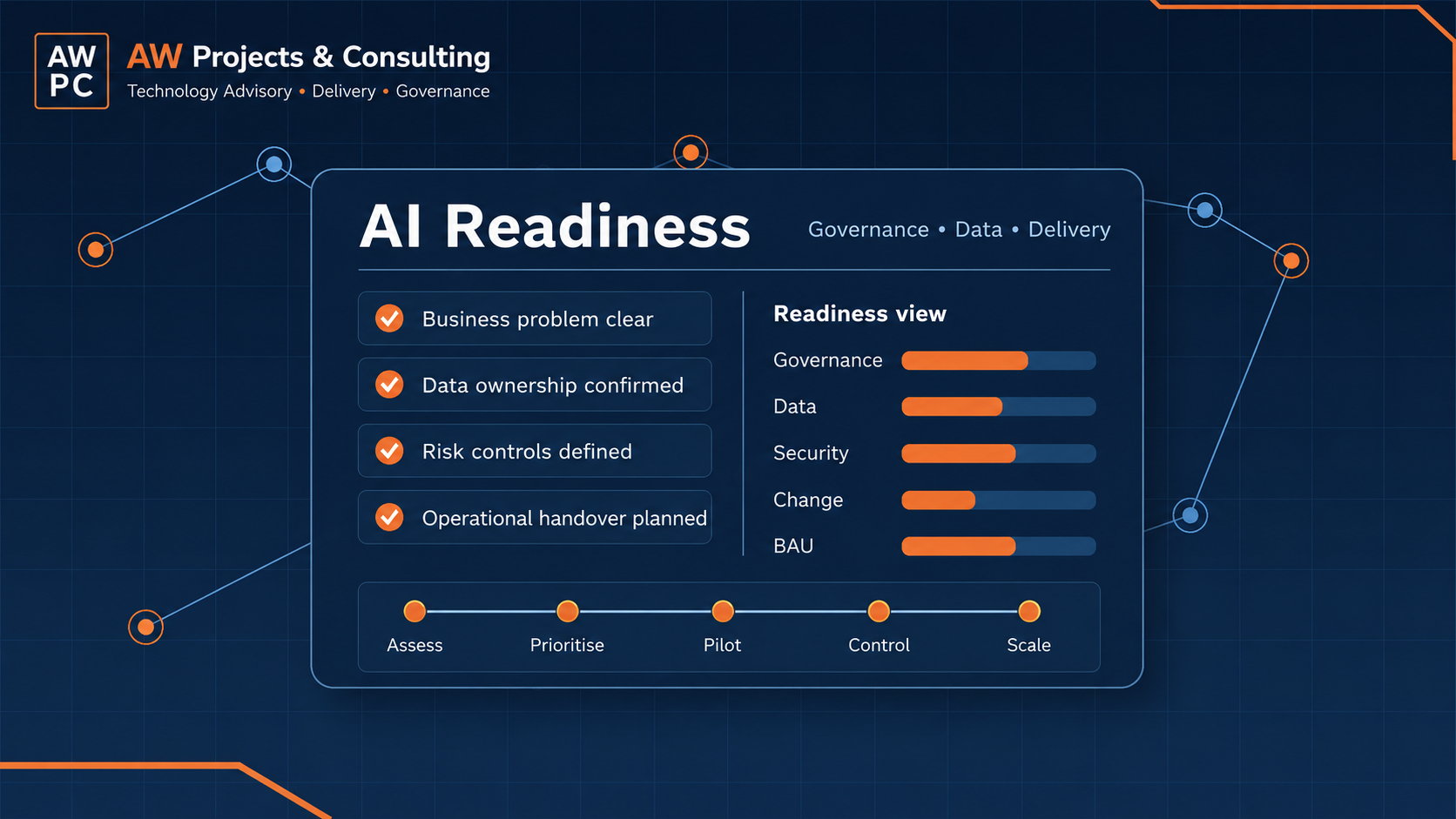
For most mid-sized organisations, the first step is to assess readiness across six practical areas.
1. Business Problem
Start with the problem, not the tool.
The organisation should be clear on what it is trying to improve. This may be speed, accuracy, service quality, reporting, compliance, decision support, cost reduction or capacity.
A good AI use case should be linked to a real business pain point.
If the benefit cannot be explained in plain English, the initiative is probably not ready.
Useful questions include:
- What problem are we solving?
- Who experiences this problem today?
- What process will change?
- What does success look like?
- How will we measure improvement?
2. Data Readiness
AI depends heavily on the quality, structure and context of the data behind it.
Poor data does not become good data because an AI tool is placed on top of it. In many cases, AI makes data issues more visible because the outputs become easier to generate and distribute.
Before scaling an AI use case, the organisation should understand:
- What data is being used.
- Where that data comes from.
- Who owns it.
- Whether it is accurate enough for the intended purpose.
- Whether sensitive or confidential information is involved.
- How data will be retained, protected and accessed.
This is especially important for organisations working across finance, operations, workforce management, customer records, projects, assets, compliance or safety-related environments.
3. Governance and Decision Rights
AI needs clear ownership.
Someone needs to decide whether a use case is appropriate, what risk level it carries, who can approve it and how it will be monitored.
This does not mean every AI idea needs to go to an executive committee.
It does mean the organisation needs a simple way to classify use cases.
For example:
- Low-risk productivity support.
- Internal reporting and analysis.
- Customer-facing communication.
- Operational decision support.
- Compliance, safety, finance or legally sensitive use cases.
Each level should have a matching level of review.
The practical message is simple: governance should match the risk.
Too little governance creates exposure. Too much governance stops useful innovation.
4. Security, Privacy and Compliance
AI can create new pathways for data leakage, unauthorised access, poor record keeping and uncontrolled decision-making.
This is not just an IT security issue.
It is a business risk issue.
Before deploying AI into business workflows, organisations should consider:
- What data users can upload.
- Whether customer, employee or commercial information is involved.
- Whether outputs need to be retained as records.
- Whether the tool is approved for business use.
- Whether vendors can access, store or train on business data.
- Whether outputs could influence regulated, financial, contractual or safety decisions.
For many businesses, the first control may be as simple as an acceptable use policy, approved tool list, data handling rules and a review process for higher-risk use cases.
That is a much better starting point than pretending AI use is not already happening.
5. Change and Adoption
AI adoption is not just about switching on a tool.
People need to understand when to use it, when not to use it and how to check the output.
This is where many businesses underestimate the change effort.
Staff may be excited, cautious, sceptical or worried about what AI means for their role. Leaders may expect productivity gains without changing processes. Teams may use AI inconsistently, creating different standards across the business.
A practical adoption plan should include:
- Clear guidance on acceptable use.
- Examples of approved use cases.
- Training tailored to real business processes.
- Human review expectations.
- Escalation points for uncertainty.
- Feedback loops from users.
- Communication from leaders on why the change matters.
KPMG’s 2026 research found Australian businesses are more focused on AI governance than the global average, but less focused on AI-driven productivity gains. That gap matters. Governance and productivity should not be competing priorities. Good governance should make AI easier to trust, use and scale.
6. Operational Readiness
The final question is whether the business can operate the AI-enabled process after the initial project or pilot team steps away.
This is where delivery discipline becomes critical.
Before go-live, the organisation should know:
- Who owns the process.
- Who supports the tool.
- How issues are logged and resolved.
- How outputs are checked.
- What happens if the AI tool is unavailable.
- How changes are approved.
- How benefits are measured.
- When the use case should be reviewed.
Go-live is not the finish line.
The real test is whether the business can operate confidently after the project team steps back.
How to Start Safely
For most mid-sized organisations, the best approach is not to create a large AI transformation program on day one.
A better starting point is to build a simple AI readiness pathway.
This may include:
- Create a short list of current and proposed AI use cases.
- Classify each use case by business value and risk.
- Identify where sensitive data, customer impact or operational decisions are involved.
- Select one or two practical use cases for controlled implementation.
- Define ownership, data rules, review points and success measures.
- Train the users involved.
- Review outcomes before scaling further.
This creates momentum without losing control.
It also helps business leaders separate useful AI opportunities from interesting distractions.
Not every AI idea should become a project.
Not every AI tool should become part of the operating model.
The goal is not to slow innovation. The goal is to make sure the organisation can scale the right ideas safely.
What Business Leaders Should Look For
A business is more likely to be AI-ready when it can answer these questions clearly:
- Which AI use cases are already happening across the business?
- Which tools are approved?
- What data can and cannot be used?
- Who approves higher-risk use cases?
- How are outputs checked?
- What business process is changing?
- What risks are being introduced?
- What benefits are expected?
- Who owns the process after implementation?
- How will the organisation know whether AI is delivering value?
If these questions feel difficult to answer, that does not mean the business should stop exploring AI.
It means the business needs a readiness layer before scaling.
That readiness layer might include a simple governance model, a use case assessment template, a pilot framework, data controls, staff guidance, vendor review questions and an implementation roadmap.
For many organisations, that is enough to move from experimentation to controlled adoption.
Building Confidence Before You Commit
AI has real potential to improve productivity, decision-making and service delivery.
But the organisations that benefit most will not simply be the ones that adopt the newest tools first.
They will be the organisations that connect AI to clear business problems, reliable data, practical governance, secure operating models and well-managed change.
Technology selection is not just a software decision.
It is a business decision.
Before committing to a tool, vendor or implementation path, it can be useful to test the business case, delivery risk and operating model assumptions.
AW Projects & Consulting can help review readiness, clarify requirements and create a practical delivery path before investment decisions are locked in.