AI adoption is no longer limited to formal technology projects.
It is already happening inside everyday work.
Staff are using AI to summarise documents, rewrite emails, analyse spreadsheets, prepare reports, draft policies, interpret contracts, create meeting notes and speed up customer responses. In many cases, they are doing this because they are trying to be more productive, not because they are trying to bypass the business.
That is what makes shadow AI difficult.
The problem is rarely malicious intent. The issue is that AI use can spread faster than governance, cyber security, data controls and operating procedures can keep up.
For mid-sized organisations, this creates a practical delivery challenge. AI is not just a technology decision. It is now an operating model, risk and governance decision.
What Is Shadow AI?
Shadow AI is the use of artificial intelligence tools without formal business approval, oversight or control.
It may include employees using personal AI accounts, browser extensions, free online tools, unmanaged software features or AI functionality already embedded inside common business platforms.
The risk is not simply that a tool exists outside IT.
The risk is that business information may be copied into that tool, relied on for decisions, used to generate customer-facing material, or embedded into processes without anyone checking whether it is safe, accurate, compliant or appropriate.
Australian cyber guidance for small and medium businesses now specifically highlights AI-related risks such as data leaks, privacy breaches, unreliable or manipulated outputs, and supply-chain vulnerabilities. It also warns that sensitive customer, staff or financial information entered into AI platforms can create privacy and security exposure if it is not properly managed.
For business leaders, that means AI governance cannot be left as an informal “use your judgement” activity.
Judgement still matters, but it needs guardrails.
Why This Matters for Mid-Sized Organisations
Large enterprises often have dedicated cyber, architecture, legal, procurement, data governance and risk teams.
Many growing organisations do not.
Instead, AI adoption may be happening across operations, finance, sales, HR, engineering, project delivery and administration without a central view of who is using what, what data is being entered, and which outputs are being relied upon.
That creates five common risks.
First, sensitive information may be entered into tools that have not been assessed.
Second, AI outputs may be treated as accurate without verification.
Third, staff may create inconsistent process workarounds that become hard to unwind.
Fourth, vendors may introduce AI features into existing systems without clear approval or impact assessment.
Fifth, leaders may believe the organisation is “not using AI yet”, when in reality it is already being used every day.
This is why shadow AI is not only an IT issue.
It affects governance, project delivery, procurement, cyber security, records management, privacy, compliance, operational readiness and executive accountability.
Gartner has identified shadow AI as a critical GenAI blind spot, reporting that a 2025 survey of cybersecurity leaders found 69% of organisations suspected or had evidence of employees using prohibited public GenAI. Gartner also warned that unauthorised AI can contribute to IP loss, data exposure and increased security risk.
The practical lesson is simple.
If people are already using AI, the organisation needs a controlled way to make that use visible, safe and useful.
The Real-World Delivery View
Many organisations approach AI in one of two ways.
Some move too quickly. They buy tools, enable features or encourage experimentation before the business has agreed what data can be used, what outputs require review, and who owns the risk.
Others move too slowly. They block everything, create uncertainty, or avoid the topic entirely. Staff then find their own tools because the business has not provided a safe alternative.
Neither approach works particularly well.
Good AI governance should not be designed to stop sensible use. It should help the organisation adopt AI safely, consistently and with enough control to protect the business.
The Australian Government has already been considering guardrails for AI in high-risk settings, with proposed expectations intended to address AI-related risks and harms, build public trust and give businesses greater regulatory certainty.
Even where a business is not operating in a high-risk AI environment, the direction of travel is clear. Organisations will increasingly need to show that AI use is understood, governed and proportionate to the risk.
For project sponsors, executives and technology leaders, that means AI adoption should be managed like any other business change.
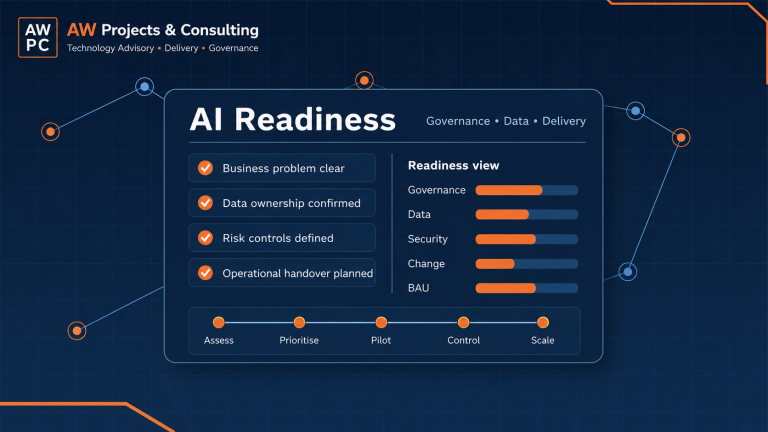
It needs ownership, scope, risk assessment, vendor assessment, process impact review, training, operating controls and a clear path into business-as-usual.
Warning Signs That Shadow AI Is Already Happening
Shadow AI is often visible if you know where to look.
Common warning signs include:
- Staff referencing AI-generated analysis without explaining the source.
- Customer emails, reports or proposals suddenly changing tone or format.
- Sensitive documents being summarised using free online tools.
- AI browser extensions appearing across user devices.
- Teams creating their own AI workflow without cyber, legal or data review.
- Vendors promoting new AI functionality inside existing systems without a formal change process.
- Policies saying AI is not approved, while day-to-day work suggests otherwise.
- Leaders asking for AI productivity gains without funding the governance needed to support them.
None of these signs automatically mean something has gone wrong.
They do mean the business needs visibility.
The issue is rarely that people are not working hard. It is usually that the operating model is unclear.
A Practical Starting Point
A sensible first step is not to write a long AI policy that nobody reads.
Start by building a simple AI usage register.
This does not need to be complicated. Capture the tool name, business area, use case, data being used, whether customer or staff information is involved, vendor terms, approval status, risk rating and business owner.
From there, sort use cases into three groups.
Low-risk productivity use might include drafting internal notes, rewriting non-sensitive text or generating ideas from public information.
Controlled business use might include analysing internal documents, summarising operational reports, supporting tender responses or preparing customer-facing content.
High-risk or restricted use might include personal information, financial records, legal interpretation, safety decisions, regulated data, source code, credentials, confidential commercial data or automated decisions that affect customers or staff.
This gives leaders a practical view of where AI is being used and where controls are needed.
It also helps avoid over-governing harmless use while under-governing serious risk.
What Good AI Governance Should Include
For most mid-sized organisations, AI governance should be practical rather than heavy.
A right-sized model should include:
- A clear policy on what staff can and cannot enter into AI tools.
- Approved AI tools and approved use cases.
- A simple process for requesting new AI use cases.
- Data classification rules that explain what information is restricted.
- Vendor assessment questions for AI-enabled software.
- Human review requirements for outputs that affect decisions, customers, compliance or reporting.
- Cyber and privacy checks before sensitive information is used.
- Training that explains practical scenarios, not just abstract principles.
- Ownership across business, technology, risk and operations.
- Periodic review as tools and business use cases change.
The NIST AI Risk Management Framework and its Generative AI Profile are useful reference points because they focus on identifying AI risks and applying risk management actions that align with organisational goals and priorities.
The key is not to copy a large enterprise model.
The key is to create enough structure that people can make better decisions faster.
Vendor AI Needs Special Attention
Shadow AI is not only created by staff using public tools.
It can also arrive through vendors.
Many software platforms are adding AI features into products that businesses already use. These features may summarise records, generate recommendations, automate workflows, classify information or support customer interactions.
That does not make them bad.
It does mean vendor-led AI needs proper review.
Before enabling vendor AI functionality, business leaders should ask:
- What data does the AI feature access?
- Is our data used to train or improve the vendor’s model?
- Where is the data stored and processed?
- Can the feature be switched off?
- Are outputs explainable and auditable?
- What happens if the AI output is wrong?
- Who owns the business decision made using the output?
- How does the vendor manage security, privacy and model risk?
- What change, training and support is needed before users rely on it?
Vendor-led delivery still needs client-side control.
The vendor can own the feature, but the business owns the outcome.
AI Agents Raise the Stakes
The next wave of risk is not just AI that answers questions.
It is AI that takes action.
AI agents may be able to read information, trigger workflows, update records, draft responses, make recommendations or interact across systems. That creates a different risk profile because the issue is no longer only what the tool says. It is what the tool can do.
Gartner has warned that applying the same governance approach to all AI agents can lead to failure, especially where organisations do not distinguish between an agent’s ability to act and the scope of access it has been granted. Gartner also predicts that by 2027, 40% of enterprises will demote or decommission autonomous AI agents due to governance gaps identified after production incidents.
That matters for mid-sized organisations because AI agent capability may arrive inside tools they already use.
The practical control is to match governance to risk.
A read-only assistant that summarises approved documents is not the same as an agent that updates customer records, changes schedules, raises purchase orders or sends external communications.
Access, approval, monitoring and escalation should reflect the level of autonomy.
How to Start Safely
A practical 30-day starting point could look like this:
Week 1: Create visibility
Ask each business area where AI is already being used. Keep the tone constructive. The goal is not to punish people. The goal is to understand what is happening.
Week 2: Sort risk
Classify use cases based on data sensitivity, business impact, customer impact, compliance exposure and whether outputs influence decisions.
Week 3: Set minimum controls
Agree what tools are approved, what data is restricted, when human review is required and what use cases need formal approval.
Week 4: Communicate and embed
Give staff practical examples. Explain what is allowed, what is not allowed, and where to go for support. Make the approved path easier than the workaround.
This approach creates momentum without pretending that AI governance can be solved by a single policy document.
The Leadership Question
The leadership question is not, “Are we using AI?”
Most organisations already are, whether formally or informally.
The better question is:
Do we know where AI is being used, what data is involved, what decisions it influences, and who is accountable if something goes wrong?
If the answer is unclear, the organisation does not need panic.
It needs structure.
AI can create real productivity benefits, but only when adoption is supported by practical governance, clear ownership and a realistic delivery model. KPMG’s 2026 Australian AI research found Australian businesses were ahead of global peers on AI governance focus, but behind on prioritising AI-driven productivity. That suggests the opportunity is not simply to “use more AI”; it is to connect responsible adoption with practical business value.
For growing organisations, that is the real work.
Not banning AI.
Not chasing hype.
Building the operating model that lets the business use AI safely, confidently and effectively.
Need an Independent Perspective?
Every organisation’s technology journey is different.
Whether you are evaluating AI tools, reviewing vendor AI functionality, improving governance, or trying to reduce delivery and cyber risk, an independent perspective can often identify opportunities and challenges before they become expensive problems.
AW Projects & Consulting can help review readiness, clarify requirements and create a practical delivery path before investment decisions are locked in.